What Happens During a Professional Tree Health Assessment?
Looking Beneath the Surface
Trees often appear healthy until they do not. A full canopy and green leaves can hide structural weakness, root stress, or early disease. This is where a professional tree health assessment becomes essential.
Rather than reacting to visible damage, a tree health assessment evaluates the entire tree system. The goal is to understand current condition, identify risks, and guide care decisions before problems become costly or dangerous.
Why Tree Health Assessments Matter
Trees are long-term assets. They influence property safety, appearance, and value. When trees fail, the damage can be sudden and severe.
A tree health assessment provides clarity. It answers practical questions. Is the tree stable? Is decline reversible? What care is needed now, and what can wait?
For homeowners and property managers, this process replaces guesswork with informed planning.
Initial Site Observation
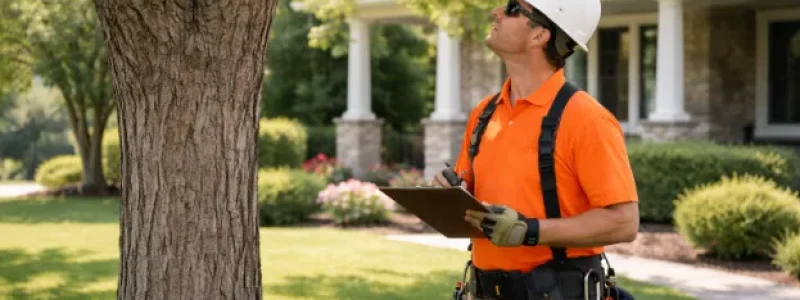
A professional assessment begins before the arborist touches the tree. The surrounding environment offers critical context.
The assessor notes nearby structures, walkways, soil conditions, drainage patterns, and exposure to wind. Recent construction or grading changes are especially important.
Tree health does not exist in isolation. Site conditions often explain why stress develops.
Visual Tree Inspection
The first direct step is a full visual inspection. This includes the canopy, trunk, and visible root flare.
In the canopy, the arborist looks for thinning foliage, dead branches, uneven growth, and leaf discoloration. These signs may indicate nutrient imbalance, pest activity, or internal decay.
The trunk is checked for cracks, cavities, seams, and fungal growth. These features often point to structural weakness beneath the bark.
At ground level, the root flare is examined. Buried or damaged root flares restrict oxygen flow and lead to decline.
Evaluating Tree Structure
Structure determines safety. A tree health assessment pays close attention to branch attachment and weight distribution.
Weak branch unions, included bark, and excessive end weight increase failure risk. Trees that lean are evaluated for root stability and soil movement.
Structural issues do not always require removal. Many can be managed with corrective pruning or support planning when identified early.
Root Zone Assessment
Roots support everything above ground. Their condition often determines a tree’s future.
The arborist evaluates soil compaction, moisture levels, and surface disturbance. Foot traffic, vehicles, and equipment can compress soil over time.
Signs of root stress include sparse canopy growth, early leaf drop, and surface root damage. A thorough tree health assessment considers how the root zone can be protected or improved.
Identifying Pests and Disease
Many tree pests and diseases progress slowly. Early stages are easy to miss without training.
During a tree health assessment, the arborist looks for insect damage, bore holes, sap flow, and leaf pattern changes. Fungal growth on bark or at the base of the tree is also noted.
Accurate identification matters. Treatment depends on the specific cause, not just the symptom.
Soil and Nutrient Considerations
Healthy soil supports healthy trees. Poor soil limits growth and weakens defenses.
A tree health assessment often includes discussion of soil quality, nutrient availability, and organic matter. In some cases, soil testing may be recommended.
Addressing soil health improves long-term outcomes more effectively than surface treatments alone.
Assessing Environmental Stress
Trees respond to their environment over time. Drought, temperature swings, and storm exposure leave lasting effects.
The arborist considers recent weather patterns and how the tree has responded. Stress from past events may not show immediate damage but can reduce resilience.
Understanding environmental pressure helps predict future performance.
Risk Evaluation and Safety Planning
One of the most important outcomes of a tree health assessment is risk evaluation.
The arborist considers tree condition alongside potential targets. A healthy tree in an open area presents different concerns than a declining tree near a home or roadway.
Risk is assessed realistically. Not every defect requires action, but serious hazards must be addressed.
Recommendations and Priorities
After evaluation, the arborist provides clear recommendations. These may include pruning, soil improvement, pest management, monitoring, or removal.
A professional tree health assessment does not push unnecessary work. It prioritizes actions based on urgency and benefit.
This guidance allows property owners to plan care responsibly over time.
Ongoing Monitoring
Trees change from season to season. A single assessment offers a snapshot, not a lifetime guarantee.
Many properties benefit from periodic tree health assessments, especially for mature or high-value trees. Monitoring allows adjustments as conditions evolve.
This approach supports long-term stability and safety.
The Arbor Plus Approach
At Arbor Plus, a tree health assessment is both technical and practical. It combines arboricultural knowledge with real-world decision making.
The focus is not just on tree survival, but on safety, property impact, and long-term care value. Every recommendation is grounded in observation and experience.
Informed Care Starts With Understanding
Trees cannot explain what they need. A professional tree health assessment gives them a voice through careful evaluation.
By understanding tree condition before problems escalate, property owners protect their landscape and avoid costly surprises.
Tree care works best when guided by knowledge, not reaction.