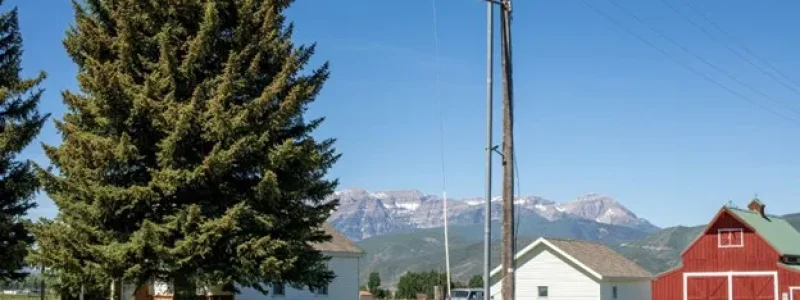
Trees and power lines often share limited space in residential and commercial areas. As trees grow, branches can extend toward overhead utility lines, creating a situation that requires careful attention. What begins as a small branch may eventually reach a line, interfere with utility service, or create a serious hazard during strong winds and storms.
Pruning trees near power lines is different from ordinary landscape pruning. Electricity introduces risks that homeowners should never underestimate. A branch, tool, ladder, or person does not always need to touch a power line to create a dangerous situation.
For Utah property owners, understanding when professional tree pruning is necessary can help protect people, property, trees, and utility infrastructure.
Why Trees Grow Toward Power Lines
Trees grow in response to available light and surrounding conditions. If a tree is planted near an overhead utility line, branches may gradually extend into the open space around the line.
Trees can also become a concern when utility lines are installed near existing vegetation.
Over several years, normal growth can change the amount of clearance between the tree and the power line.
This is why trees near utility lines should be monitored regularly rather than waiting until branches are visibly touching the wires.
Why Power Lines Create a Serious Hazard
Overhead power lines can carry enough electrical energy to cause severe injury or death.
A common mistake is assuming that a person must directly touch a wire to be exposed to electricity. Electrical current can travel through conductive materials and may arc across a gap under certain conditions.
Moisture, equipment, ladders, pruning tools, branches, and other materials can increase the danger.
For this reason, homeowners should never attempt to trim branches that are close to energized utility lines.
Recognize Warning Signs Early
Property owners should regularly observe trees located near overhead lines.
Warning signs can include:
- Branches growing toward utility wires
- Branches touching or resting on lines
- Limbs hanging close to electrical conductors
- Trees leaning toward utility infrastructure
- Dead branches suspended above power lines
- Storm-damaged limbs near utility equipment
- Fast-growing branches reducing existing clearance
A tree does not have to be touching a line to require professional attention.
If branches are approaching the clearance area around a power line, contact an appropriate professional before attempting any pruning.
Do Not Use Ladders Near Utility Lines
Ladders can create an additional hazard during tree work.
A homeowner may be able to reach a branch from a ladder, but the ladder itself can become a dangerous pathway if it contacts or approaches an electrical line.
Metal ladders present an obvious concern, but other ladder materials should not be treated as automatically safe around energized lines.
Tree pruning should never be performed from a ladder positioned near power lines.
Avoid DIY Pruning Near Electrical Wires
Routine pruning around a yard may seem simple. Tree work near utility lines is different.
Branches can move unexpectedly. Cutting one limb can cause another branch to shift. Wind can move both branches and equipment.
There is also a risk that a branch under tension may fall in an unexpected direction.
Homeowners should not use saws, pole pruners, ladders, or other equipment near power lines.
Professional tree care providers understand the hazards associated with overhead utilities and can determine whether the work should be performed by qualified personnel or coordinated with the utility company.
Professional Pruning Requires Planning
Pruning near power lines should begin with an assessment of the tree and the surrounding area.
A professional can consider the tree’s size, species, branch structure, growth pattern, location, and proximity to electrical infrastructure.
The objective is to address the clearance concern while considering the long-term health and structure of the tree.
Improper cutting can create weak branches, decay points, and uneven growth.
The pruning method should therefore account for both safety and tree health.
Avoid Topping Trees Near Power Lines
Some property owners believe that cutting the top of a tree will prevent future conflicts with utility lines.
Topping is generally a poor approach to tree care.
Removing large portions of the canopy can create large wounds and encourage rapid regrowth. New branches may grow from weak points and can eventually create another clearance problem.
A better approach involves appropriate pruning based on the tree’s structure and location.
In some situations, the safest long-term solution may involve removing a tree that is poorly positioned beneath utility infrastructure and replacing it with a species suited to the available space.
Consider Tree Selection Before Planting
Preventing future utility conflicts begins with planting decisions.
Trees should be selected according to their mature size, crown shape, root characteristics, and available growing space.
Planting a large-growing species directly beneath an overhead power line can create a recurring maintenance problem.
Homeowners and property managers should consider the tree’s expected mature height before planting.
A small tree at the time of planting may eventually grow into a much larger canopy.
Choosing an appropriate species and location can reduce future pruning requirements.
Storm Damage Requires Extra Caution
Storms can change the situation quickly.
High winds, heavy snow, and ice can break branches and push trees into utility lines.
If a storm-damaged tree is touching a power line, stay away from the area.
Do not attempt to move the branch, cut the tree, or pull vegetation away from the line.
Contact the appropriate utility provider or emergency service according to the circumstances.
After the area has been made safe, a qualified tree professional can evaluate the tree and determine what work is necessary.
Trees Can Also Damage Utility Infrastructure
Branches near power lines can cause more than a safety concern.
Contact between vegetation and electrical conductors can interrupt service. Falling limbs can damage lines, poles, transformers, and other infrastructure.
Repeated contact can also damage the tree.
Regular inspections and appropriate pruning can help reduce these conflicts before they become more serious.
Utah’s Weather Makes Monitoring Important
Utah properties experience a range of weather conditions throughout the year.
Dry periods can affect tree health and branch strength. Strong winds and winter weather can place additional stress on mature trees.
Trees that are already weakened by drought, disease, pests, or structural defects may be more vulnerable during severe weather.
Property owners should pay particular attention to trees near utility lines after storms or periods of unusual weather.
Know When to Contact a Professional
Professional tree pruning is appropriate whenever branches are close to energized power lines or when the work requires climbing, specialized equipment, or difficult cuts.
It is also wise to seek professional assistance when a large tree has significant deadwood, structural damage, or storm-related problems near utility infrastructure.
Arbor Plus provides professional tree care services in Utah and can help property owners assess trees, identify pruning needs, and determine appropriate maintenance options.
Where electrical infrastructure is involved, tree work may also need to be coordinated with the utility provider.
Protect People and Trees With Proper Planning
Trees near power lines require a different level of attention from ordinary landscape trees.
Homeowners should monitor growth, recognize changes in clearance, avoid DIY pruning near electrical lines, and seek professional help when branches approach utility infrastructure.
The goal is to maintain appropriate clearance while preserving the tree’s health and structure whenever practical.
Regular tree inspections can also identify developing problems before branches become tangled with utility lines.
Keep Utility Clearance in Mind
A tree growing near a power line may look harmless today and create a significant problem several years later.
Regular monitoring provides an opportunity to address growth before it becomes difficult to manage.
When professional pruning is required, the work should be planned around the tree’s structure, the utility infrastructure, and the safety requirements of the site.
For Utah homeowners, working with qualified tree care professionals can help reduce unnecessary risks and protect established trees.
Proper planning also begins before a tree is planted. Selecting the right species and location can prevent many utility conflicts from developing in the first place.
When trees and power lines share the same space, safety should always guide the decision about when and how pruning is performed.